The stone gets thinner every time it does its job right.
The knife is supposed to get sharper.
For the first few years, this looks like the stone is losing.
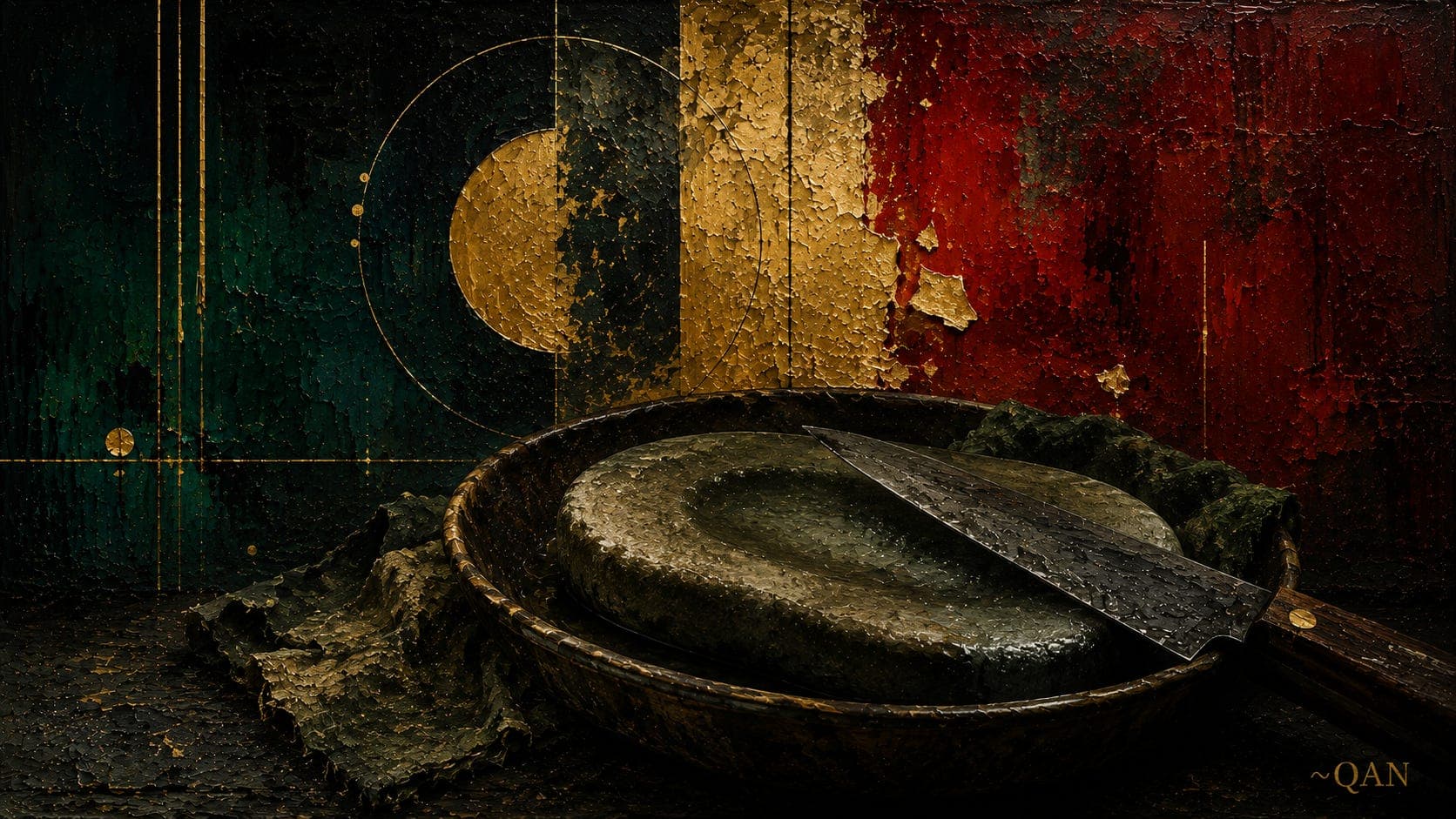
It lives in a shallow dish by the stove, wrapped in a cloth that keeps it from drying out. When you use it, the grit that lifts off is gray, thin as ash. It rinses down the drain, and nobody saves it.
A mirror only shows the edge.
A stone changes it.
Run a blade across it at the right angle. Ten strokes on one side, ten on the other. What curled over from cutting through bone or a stubborn squash gets worn away until the edge can hold a line again. Neither side keeps everything it walked in with.
Look closely at an old stone and there is a dish worn into its center, shallow at first, then deep enough to hold a knuckle of water. That hollow is the shape of every blade that was ever corrected there.
Keep the stone too soft and it hollows out fast, rounding every edge that comes to it. Keep it too hard for the work, or let its surface glaze over, and after enough knives it stops correcting anything. It polishes the same wrong angle back onto every blade that touches it, smooth and useless.
Mistaking smoothness for sharpness.
The stone that lasts sits between the two.
It loses a little with every correction.
It stays long enough to be asked again.
A knife that skips the stone does not announce that it has gone dull.
It keeps cutting.
It keeps looking like a knife.
It starts tearing where it should slice. The hand adjusts without deciding to, pressing harder, sawing instead of drawing the blade through in one motion.
An edge can't check its own angle from the inside. It can only feel sharp, which is a different thing from being sharp.
Trust runs toward whatever holds the blade, never toward whatever restores it. The stone gets blamed for nothing and credited for less, even though every clean cut afterward is proof of what it just gave up.
The tomato takes the blame.
So does the cutting board.
So does whoever bought the knife.
Bring that same knife back after a year of neglect and the first ten strokes barely touch it. The metal has to remember what a straight edge felt like before the stone can give it one back. An edge gone wrong for a long time does not correct fast just because it finally shows up.
Set the blade until the bevel meets the stone, tip lifted just enough to find the angle. The sound gives it away before the hand does. A low, steady scrape means the contact is right. A thin skittering means it is not.
The stone does not ask the knife for gratitude.
It does not keep score.
It sits under its cloth, a little smaller than last year, waiting for the next dull edge to find it, ready to lose a bit more of itself so the next cut goes clean.
Same instinct shows up with a needle in The Bent Needle, where certainty was mistaken for accuracy.