Every third season, one strip of the field stops.
No wheat goes in.
No mustard.
The rows sit turned and bare while the rest of the farm keeps its full rotation.
A farmer who had worked his land for thirty years called that strip wasted ground.
He planted his own field the same way every year.
Edge to edge. Nothing held back.
To him, a season with no crop in it was a season thrown away.
For a long time his numbers backed him up.
Then they stopped.
Each season needed more to return the same amount it gave the year before.
More fertilizer before the seed.
More water than the year before.
The ground still gave, but it gave like something asked twice for the same favor.
He started watching the neighboring field instead, the one with the empty strip.
He waited to see it fall behind.
It fell behind for exactly one season.
After that, its yield held steady through years when everyone around it dipped.
He walked the fallow rows once, during the resting season.
He expected dust and cracked clay.
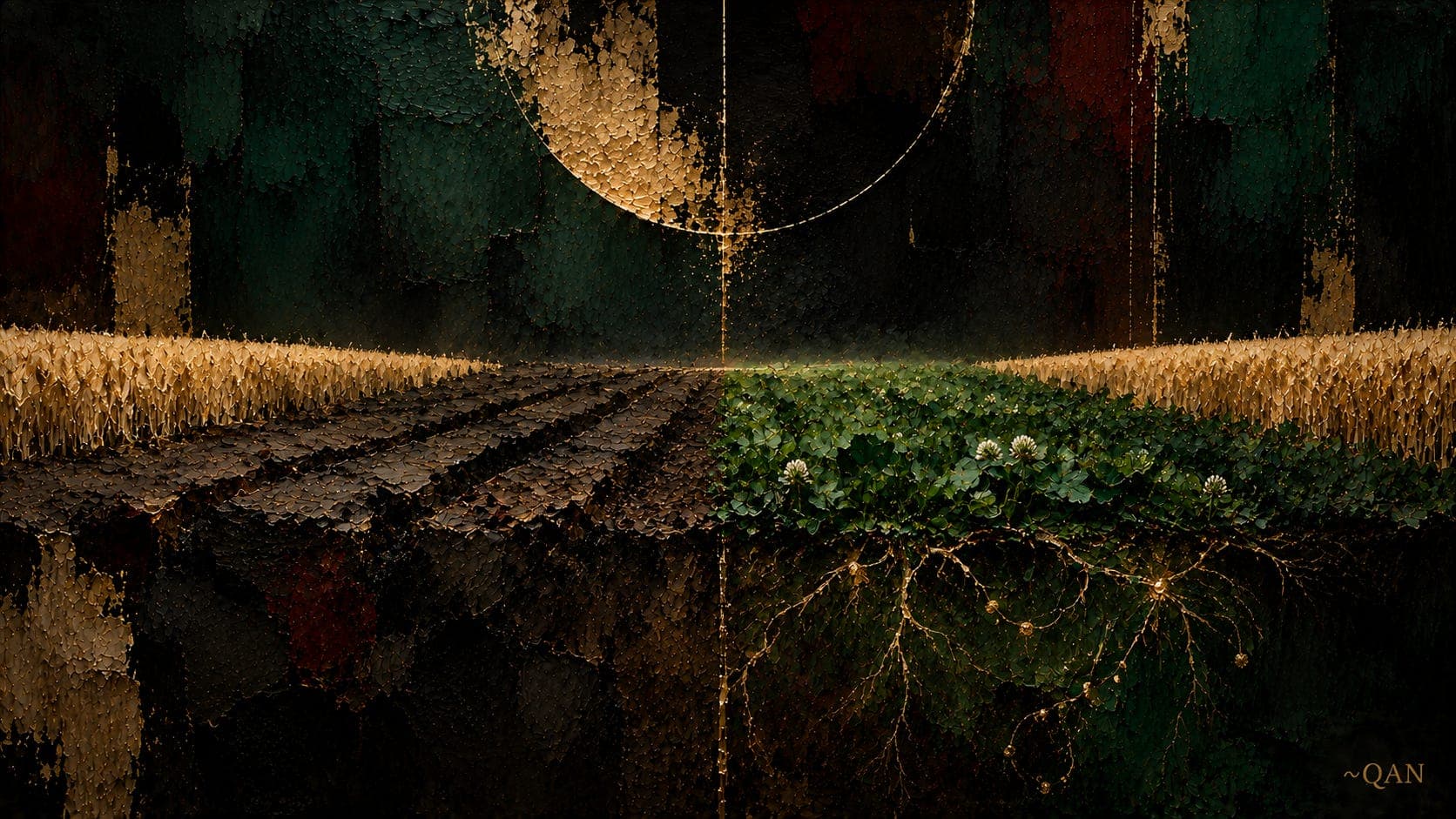
What he found was a low tangle of clover, damp at the roots, pushed deep into ground that looked abandoned from the road.
The air over it smelled of turned earth rather than crop, green and mineral at once.
Something had spent the whole season building here, quietly, in a currency no scale in the barn would ever weigh.
His neighbor explained it without ceremony, the way a man explains something he stopped finding remarkable years ago.
The bacteria at the roots take nitrogen straight out of the air.
It locks into the soil, feeding a crop that hasn’t even been planted yet.
The return sits banked below ground, credited to a harvest still several seasons away.
The clover's yield was one no ledger could read yet.
He asked how long a strip could rest before the resting itself became a new problem.
Left too long in one spot, even clover starts draining the soil of something else.
So the rest has to move too.
A new strip every few seasons.
Otherwise the fix hardens into the mistake it was meant to correct.
Even patience, parked in one spot too long, wears out the ground under it.
That autumn he marked off a strip of his own land.
Turned but unplanted.
He tested the soil first, the way his neighbor had, and logged the date on the same board where he kept his yields.
Then he walked back toward the strip that still grew nothing, and stood at the edge of it.
He waited on it the way his neighbor had taught him to.
Same trust in an unseen process shows up with a darkroom in The Darkroom, where patience and faith look identical until the print comes up.