The front wheel of a bicycle touches the road on a patch of rubber no bigger than a thumbnail.
Everything else on the machine sits above that patch.
And it stays up.
For years he assumed the hands were doing it.
His hands, on the grips, making corrections so small he could not have described one if asked.
He was fourteen when the hand on the back of the seat let go.
Warm where the hand had been.
He waited to fall.
The ride did not change.
That afternoon he watched the wheel.
It moved more than he expected.
Small turns, left, then right, then left, at a rate no hand could match.
He tried to count them.
He gave up inside a hundred metres.
The correction is built into the metal.
The tyre’s contact patch sits five or six centimetres behind the point where the steering axis meets the road, and that small offset has its own name.
Trail.
Lean the bicycle and the trail turns the wheel into the lean, before any hand has decided anything.
More than a century ago, someone tilted that axis on purpose for riders he would never meet.
A bicycle with no rider on it, shoved hard enough, will straighten itself out and keep going.
He went out to the lane the next morning to find out whether that was true of his.
Push the bars left and the wheel went further left, into a fall it was already in, and the fall straightened.
He did it twice, and then twenty more times, waiting for it to fail.
It held.
For a year he rode with his hands off the bars.
It did not work.
Below about five kilometres an hour the same wheel is useless.
The corrections arrive too slowly to catch the lean, and the machine drifts sideways under its own weight.
Hands are needed there.
That is also where a frightened rider grips hardest.
A grip that tight turns his own unsteadiness into steering.
He found that out on the lane behind the house, at a speed he could have walked.
Arms locked, shoulders up near his ears.
The wheel is not holding itself up.
It falls continuously, in a direction it keeps choosing.
A fall that is always chosen never arrives.
By twenty he could ride a kilometre without touching the bars.
It felt less like a skill than like permission.
His hands had spent six years doing the anxious work of a passenger who believes he is driving.
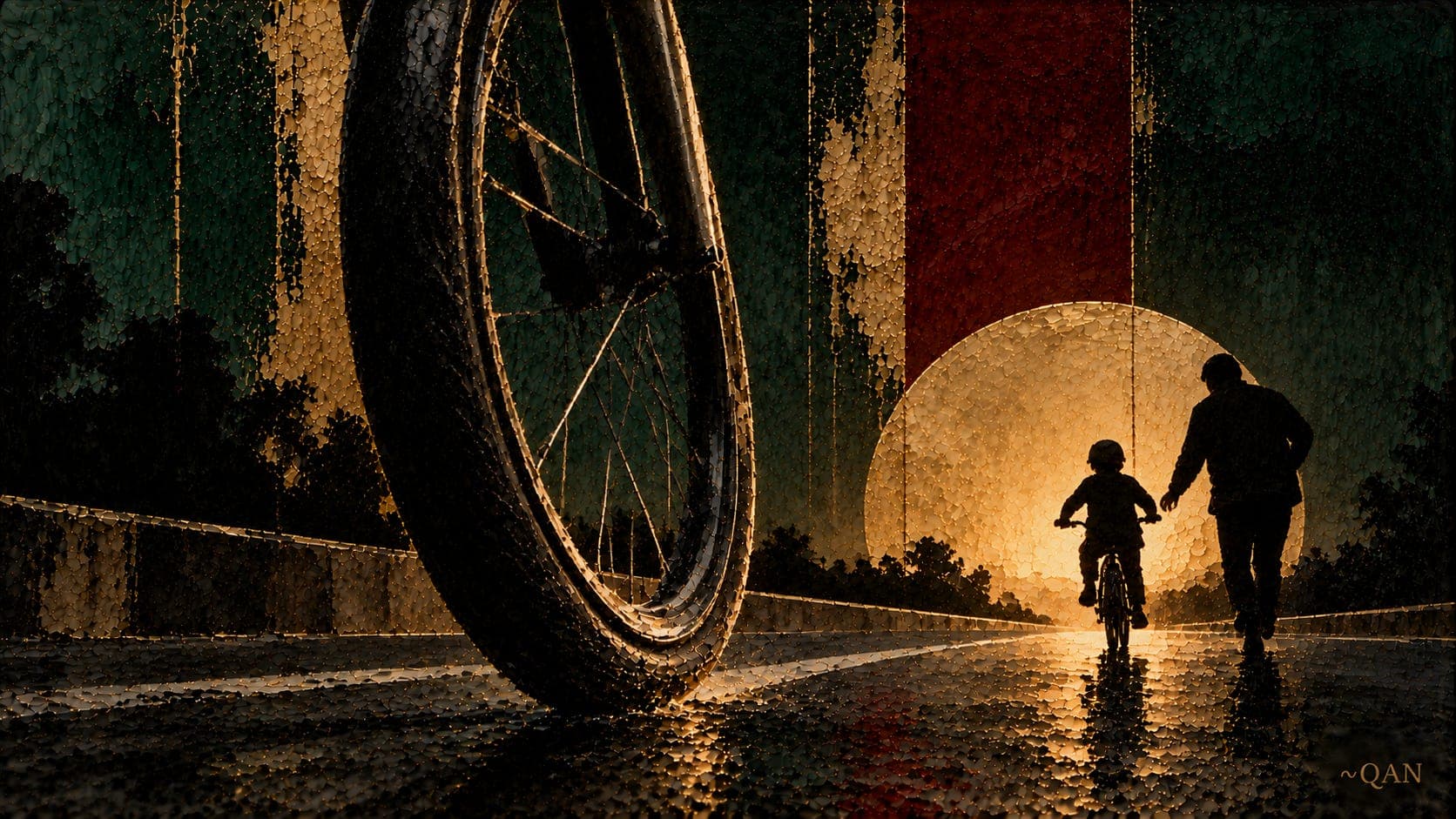
Last spring he ran beside a borrowed bicycle down the same lane.
One hand stayed on the back of a child’s seat.
The child believed that hand was holding the bicycle up.
The tyre hissed on wet tarmac.
He kept the hand there past the point where it was needed.
His fingers had gone white on the edge of the seat.
The child asked him to let go.
Taking it away felt like a decision about the child rather than about the bicycle.
When he finally opened his fingers, the front wheel was already halfway through a correction he had not seen.
The child wobbled once.
The wheel brought it back.
He walked on behind them, watching the front wheel keep choosing small falls on a patch of rubber no bigger than a thumbnail.
A wheel half an inch out of true, a click too quiet to hear, and two spokes asked to carry the difference - The Two Spokes Near the Bend.