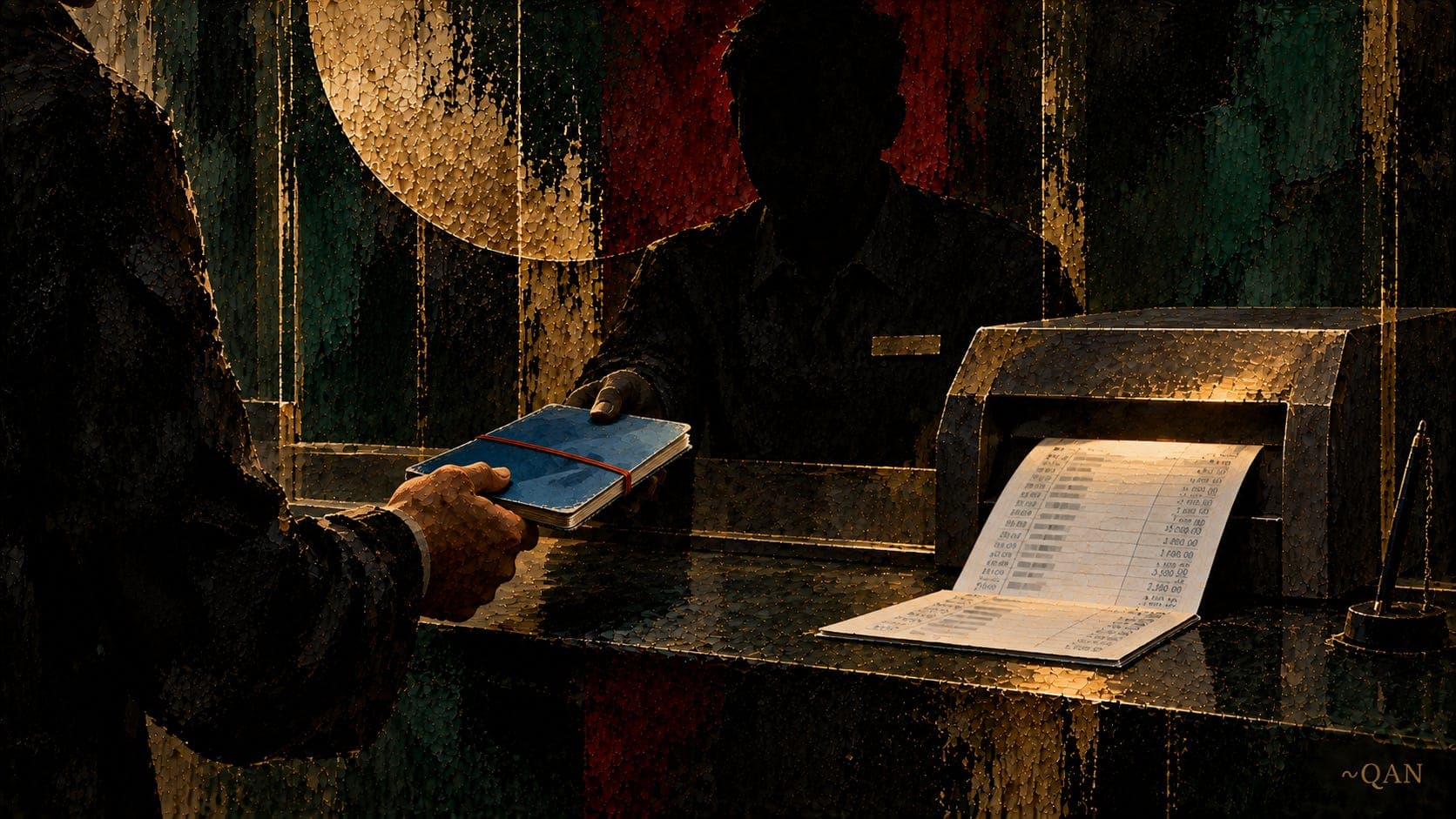
The passbook has a soft blue cover, worn pale at the corners, held together by a rubber band that isn't its own.
The clerk doesn't ask why it's been so long. He takes it, feeds it into the machine, and hands it back with new lines printed at the bottom. Every one of those lines existed before this moment. You just weren't there to see them added.
Some entries are easy to place. The withdrawal for the trip. The salary that came in a week late. Others aren't. A transfer with no memory attached to it. A month skipped altogether, sitting between two printed lines as if no time had passed there, though plenty did.
When a number surprises someone, higher or lower than expected, the first instinct is to suspect the bank.
The account kept moving the whole time the book sat shut in a drawer.
Seeing a bad number tempts a different mistake. Treating the account as finished. Deciding the damage is permanent, so there is no point checking again.
A passbook resists that too. It records entries without opinion.
Blame never gets a line of its own.
Today's deposit sits under yesterday's withdrawal and still changes what the next printed line says, even without touching the line above it.
A life works much the same way. No single day decides the balance. The small entries still count, especially the ones too minor to remember making.
What the machine hands back carries no verdict. It is only a current position, built from everything put in and everything pulled out.
The hesitation at the counter has very little to do with the queue. It has to do with admitting nobody else made the account move. Every line on that page has your hand behind it, the smallest ones especially.
Most people put off that walk longer than almost anything else they own.
A printed line does not negotiate.
Somewhere in a drawer, there is a small blue book, rubber band still holding it shut, several months behind, waiting for someone to decide whether to walk it back to the counter.
The same blindness appears in The Receipt Nobody Keeps, where keeping the proof turns out harder than earning it.