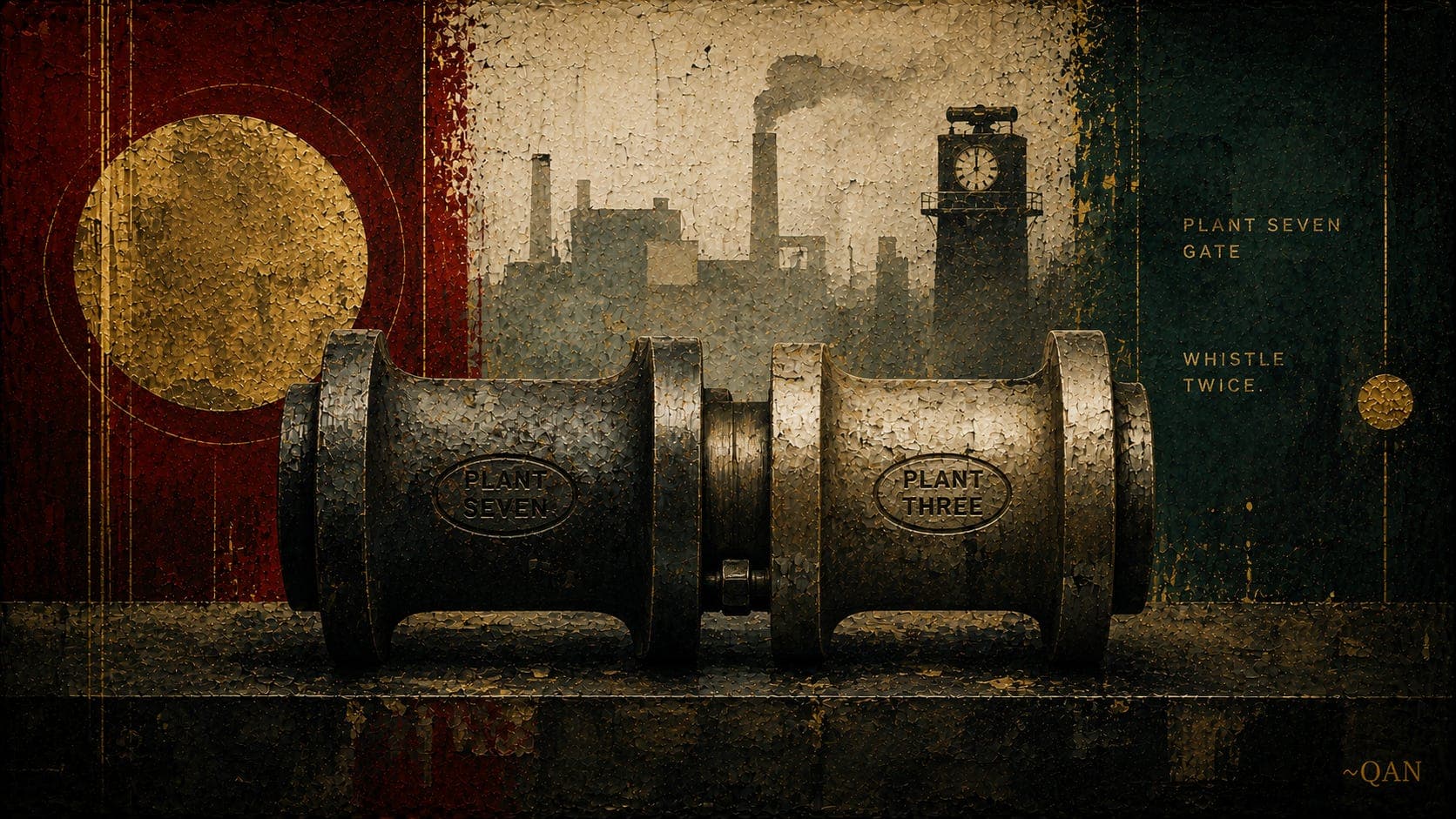
Plant Seven closed its gate at six every evening. The machinist had run the same drill press since he was nineteen. Every part that left his bench carried an oval stamp near the base, pressed while the metal was still warm.
He had made that mark ten thousand times. He had never once turned a finished part sideways to read it properly. It was just the sign that a part was done.
One winter the order sheet changed. A coupling housing from his bench now had to seat against a shaft collar machined at Plant Three, forty miles east. The two pieces would ship bolted together or not ship at all.
He had heard about Plant Three for years. Loose floor. Drifting tolerances. A man on the loading dock had told him that once, and he had believed it the way anyone believes a thing repeated often enough without measuring it themselves.
When the first crate of collars arrived, he set it aside instead of logging it in. He told the supervisor the parts needed a second look. The supervisor asked what he was looking for. He said he would know it when he found it.
The line stalled behind him. Two men from second shift stood at the rack, waiting on housings that would not move until the collars cleared. Someone asked how long. He said as long as it takes.
He turned one collar over, hunting for a flaw to justify the delay. What he found instead was the oval stamp, pressed the same way it was pressed into his own housings. Same depth. Same faint burr along the upper curve, where a die had worn on one side and never been replaced.
He set his own housing next to it. The two ovals matched down to the burr.
The tool room told him the rest the next morning. One master die cut that mark, kept in a locked drawer, loaned from plant to plant on a rotation older than his job. A roving inspector carried it between sites twice a year and signed a log that Plant Seven had never once asked to see. He had walked past that log for twenty years on his way to punch out. His face was hot on the walk back to the floor, and it had nothing to do with the drill press.
How long had he been trusting a rumor over a mark that was sitting in his own hand the whole time.
Knowing the mark came from one die did not tell him whether the collar would hold. It would have been easy to wave the crate through anyway, one assumption swapped for another, a better story instead of a truer one. Instead he asked the tool room for the master gauge and checked the collar's bore himself, the way he checked his own housings before they ever earned the oval.
The bore held to spec. He signed his half of the paperwork without a complaint attached, for the first time in twenty years.
The stamp had never belonged to Plant Seven or Plant Three. It only ever looked like it did, because nobody stayed long enough at either bench to notice the same die had made both marks.
That afternoon he mated the housing to the collar on the bench, stamp facing stamp, and turned the coupling until the bolts drew flush. It held on the first try. Behind him the rack cleared.
When the whistle blew for the gate, he was still turning the last bolt, unhurried, one oval pressed against the other, closed under a single nut.
A mark he had spent twenty years making.
A mark he had finally read.
Same instinct shows up with a role in The Costume, where a part someone was handed by accident becomes the thing they can't stop protecting.