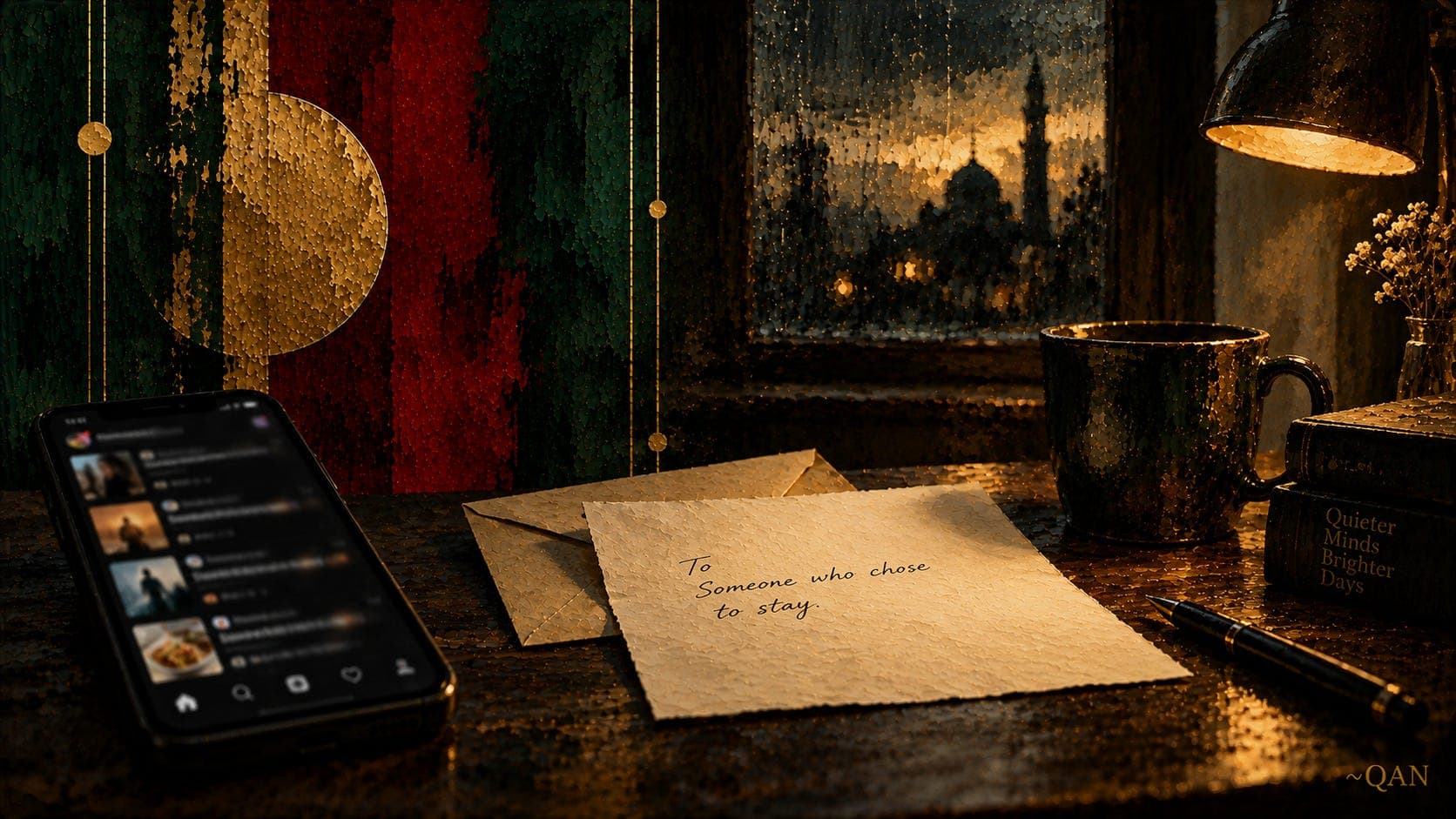
There is a difference between a person who opens an app and a person who opens a letter.
A social media user opens the app the way you check if it is raining outside. Quick, reflexive, half aware of the motion. Whatever appears next was chosen by something else, some system counting seconds of attention, and the person accepts this arrangement so completely that they no longer notice they never chose anything at all. They scroll past a grief, a joke, an ad, a stranger's dinner, in the space of six seconds. Nothing asks anything of them.
A reader opens an email.
That single difference changes everything underneath it. An email is not offered, it is received. Somewhere earlier, this person made a decision that already looks like commitment: they typed their name, gave their address, said yes to a voice they had not fully tested yet. Trust was extended in advance.
This is why the two acts of reading are not the same act wearing different clothes. They are different postures. One is consumption. The other is closer to listening.
You can watch it in how long people stay. A feed user leaves the moment something else looks brighter, and something else always looks brighter, because the whole architecture is built on the promise that the next thing might be better than this thing. But a person reading a piece by a writer they subscribed to has already paid a small cost to stay, and having paid it, they read differently. They give a paragraph the benefit of the doubt, because they are not measuring the sentence, they are measuring the relationship.
A follower is often just a number attached to what an algorithm decided to show them again. A subscriber is someone who decided, once, that a particular way of thinking was worth letting into a private space they check with intention. One of these is rented from a platform. The other belongs to no one but the two people involved.
Because of that, something happens to the reader that a feed rarely produces. A feed post is written for anyone who might stop scrolling. A piece written for a subscriber is written as if only one person is reading it, and that is often the version that reaches the most people. Specificity travels further than generality ever does.
There is also a kind of company involved that platforms struggle to manufacture. A person scrolling at midnight is often more alone at the end of the scroll than at the start of it. They have seen forty lives and touched none of them. A person who finishes reading something true, something that named a feeling they had never said out loud, closes that email less alone than when they opened it. Not entertained. Accompanied.
None of this is about one reader being better than another. It is about where the medium places them before a single word is read. One posture invites speed. The other invites attention. The writer's job is not to remind anyone which one they are in. It is to be worthy of the quiet they brought with them.
The reader gave the quiet. The least a writer can do is not waste it.