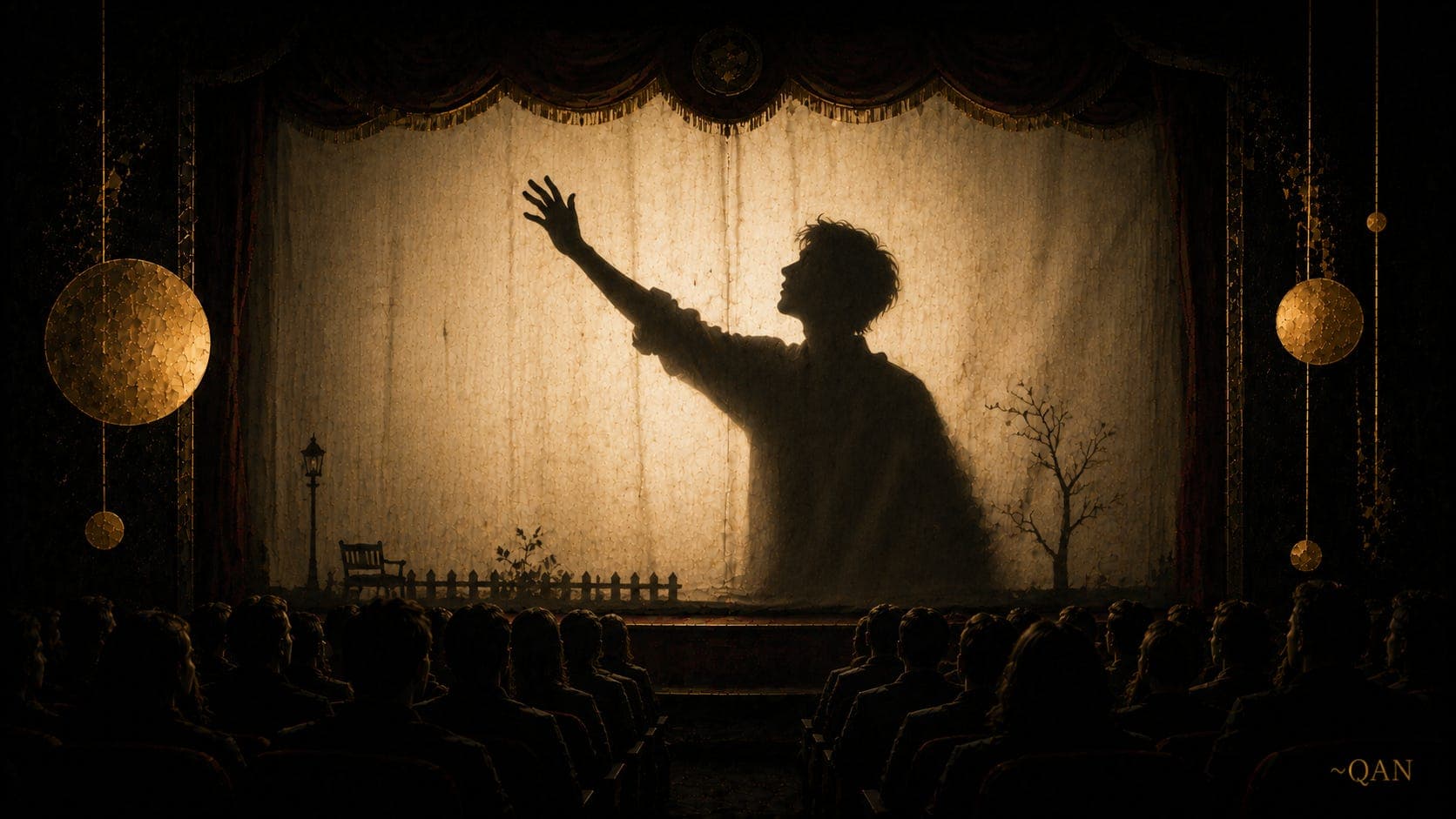
The audience settles into silence.
A white screen stands between them and the stage.
On this side of the screen, a story begins.
Behind it, another story has already been unfolding.
The lights rise.
A shadow steps onto the screen.
Nobody sees the person.
Only the shadow.
That is how most lives reach us.
We spend most of our lives meeting each other's shadows.
Very rarely the person standing behind the screen.
A smile.
A silence.
A delayed reply.
A promise.
A broken promise.
Shadows.
A shadow never lies.
It never tells the whole truth either.
It leaves gaps.
We fill them.
With memory.
With fear.
With hope.
With yesterday.
Before the shadow has crossed the screen, our minds have already decided what happened.
The audience believes it has watched the whole play.
It has only watched what the screen allowed through.
Behind it, another story never stopped unfolding.
Sleepless nights.
Conversations that never ended.
Fear that found no words.
Regret that found no witness.
None of it reached the screen.
Only the shadow did.
Sometimes someone breaks a heart.
For one person, it is another decision.
For the other, a whole world falls silent.
The event is shared.
The reality is not.
Breaking someone's heart is an action.
Having your heart broken is a universe.
Years pass.
Life quietly changes the roles.
The one who once walked away stands where someone else once stood.
Nothing new is explained.
Something new becomes visible.
The light changes.
The shadow changes.
The person behind it may not have changed at all.
Years pass.
The shadow becomes familiar.
We begin to believe we know the person.
There may not be a single person who has ever seen your whole world.
There may not be a single person whose entire world you have ever seen.
The play ends.
The lights return.
The audience walks home believing it knows the story.
Behind the screen, the larger story remains unseen.
If this shadow stayed with you, you may also find yourself standing inside "The Judge Who Never Read the Evidence," where the verdict arrived before the story did.
Or inside "The House with Perfect Rooms but No Hallway," where every room could be seen, yet nothing truly connected.