There were two paths through the trees.
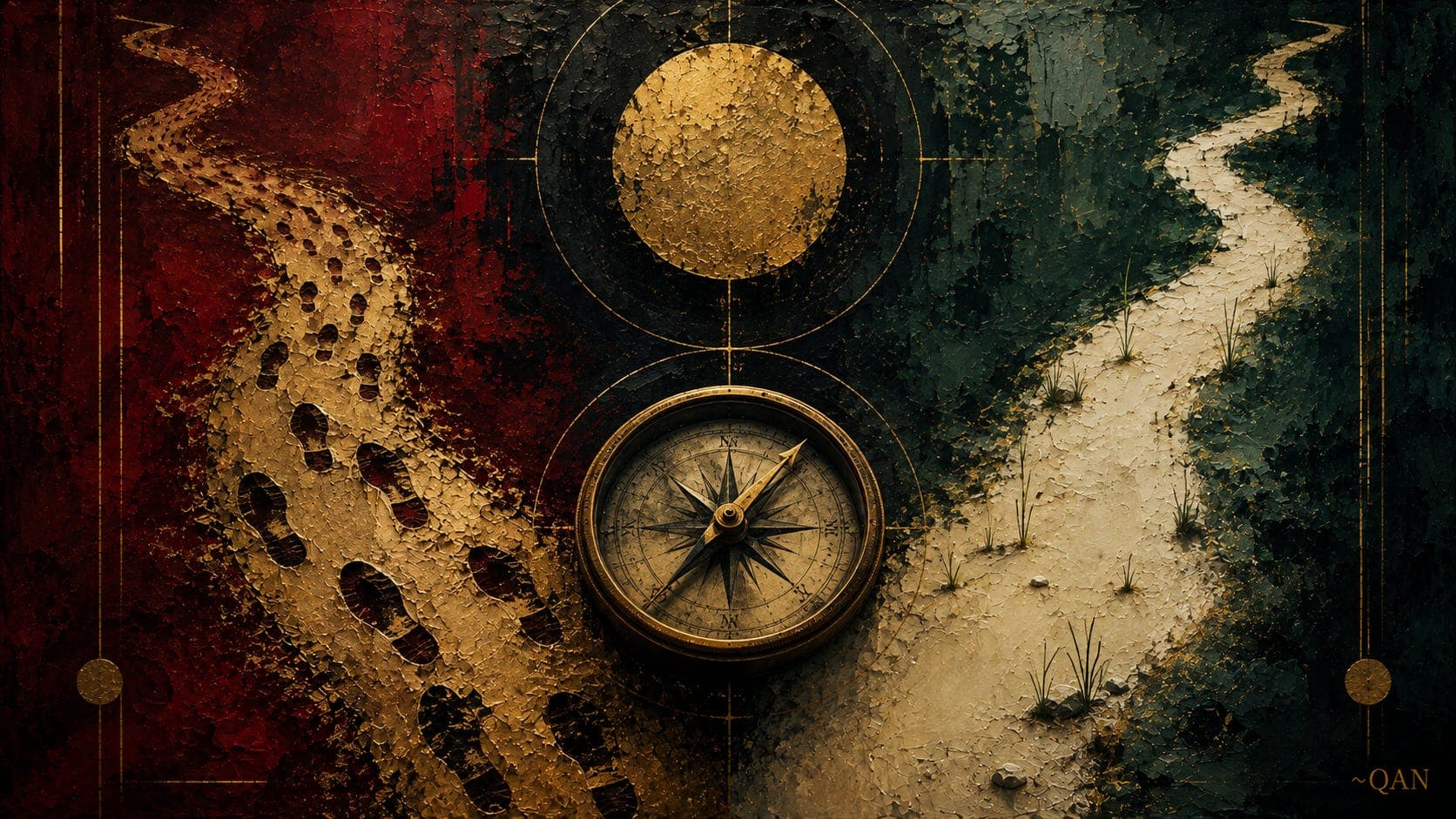
One was worn smooth by hundreds of footsteps. The other was narrow, grass still standing between the stones, as if no one had needed it yet.
The first path felt easier to choose. Not because anyone had said so. It had simply been used. A person could see where the ground had been pressed down, where shoes had passed, where the stones had been cleared by hundreds of ordinary journeys.
So he stepped onto it. The first few steps felt familiar, though he had never walked there before.
At the fork he stopped and took a compass from his pocket. Its glass carried a hairline scratch from the year it had sat too close to a folding knife, and for one whole season it had pointed almost ten degrees wrong before he noticed. He had trusted it completely that season. That was the part he never forgot.
The needle settled now, steady, true enough. The path behind him was full of footprints. The path ahead was not. The needle seemed entirely uninterested in either fact.
He looked at the crowded trail again. Then at the compass. For a moment the two seemed to be saying different things.
By the time he noticed the compass, the footprints had already started to feel like an answer.
The path with the footprints did not become less real. The other path did not become more correct. There was only the uncomfortable space between what had already been chosen and what still had to be chosen, and underneath it, quieter, the memory of a compass that had once been wrong for an entire season.
The footprints on the crowded path had never once asked whether they were right. They had only multiplied.
There is a second mistake, harder to see than the first. Turn left simply because everyone else turned right, and the crowd is still choosing the direction, only from behind instead of in front. The road has changed. The reference point has not.
The empty path is not automatically the honest one. Neither is the crowded one. A compass does not become more trustworthy because fewer people are standing near it, and it does not become false because a knife once sat too close for a season. It earns trust the slow way, checked against something outside itself. He had learned to do the same, checking his against the sun at noon before believing it fully.
Some people become reference points without ever trying to become one. They keep facing the same way when nobody is watching. And they keep checking, quietly, whether that way is still true.
Then one day someone notices. Not the number of people behind them. The direction.
The trail is still there. The footprints are still there. The grass still stands between the stones on the quieter path. And the compass, scratched glass and all, is still pointing, having earned the right to be trusted the slow way.
The footprints never needed to be wrong. They only needed to belong to someone else.
If you've ever wondered how a direction can feel right simply because it has been repeated, The Finished Puzzle sits close by, where the wrong picture can become convincing one piece at a time. And The Bent Needle, where a direction can feel right long after the compass has stopped being true.