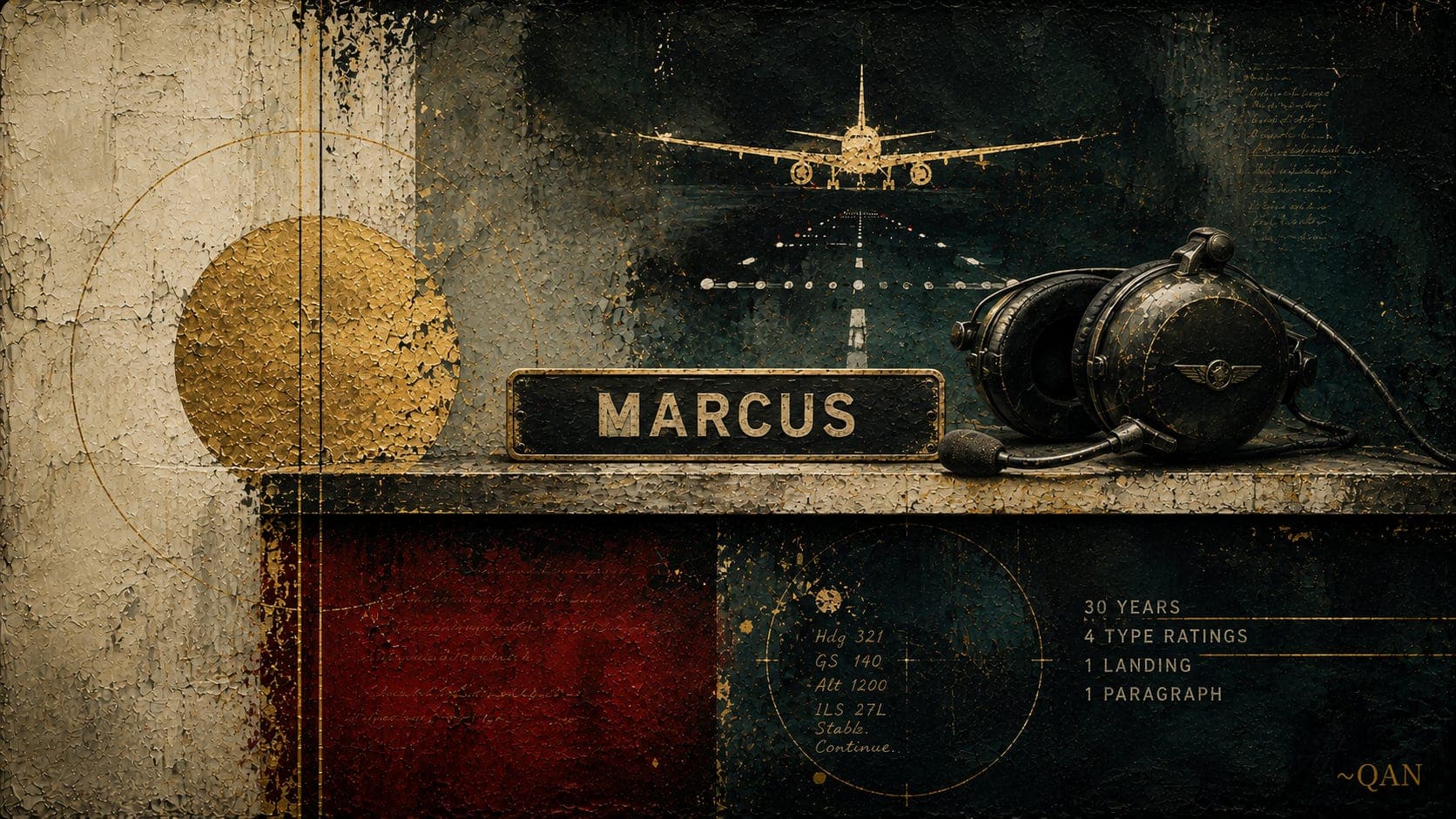
The captain's tag said Marcus. Same font, same size as the first officer's two seats over, the one who had been flying for eleven months. Thirty years of flight time did not buy him a longer nameplate.
He had four type ratings by then, a commendation for a landing in weather that grounded three other airlines that week, and a training manual his airline had rewritten around one paragraph he wrote after that flight. None of it fit on a tag the width of two fingers.
A passenger recognized him on a red-eye once, from a documentary about the landing. She asked why his badge just said Marcus. No captain, no thirty years, no medal. He told her the tag existed so a controller could reach him in four seconds instead of eleven, headset on, altitude climbing, weather closing.
The night of the landing, nobody in that cockpit called him by his record. Approach control called him Marcus, twice, fast, correcting his heading before the second call finished. His first officer called him Marcus when the glideslope needle started drifting and there wasn't time for anything longer. The record got written after the plane was on the ground, by people who had not been in it.
It would be easy to hear that and decide the record was decoration and the name was the only real thing. Eight months after the landing, the airline pulled his file for a different reason. A new captain had frozen on approach in similar weather and walked away shaken but alive. The review board didn't call for Marcus. They called for Captain, thirty years, the paragraph in the training manual, the specific sequence of decisions he'd made that night, so they could turn it into something teachable. In that room the plain name would have meant nothing. Nobody needed to reach him in four seconds. They needed the version of him that could be argued with, cited, trusted at a distance.
He'd seen the split once before, off duty, in a hospital corridor two summers earlier. A nurse ran past him calling out, "Robert, stay with us," three syllables, sharp as a directive. Ten minutes later, at the intake desk, the man's daughter recited his full name, middle initial, and date of birth to a clerk entering him into a file that would outlast the hallway. Neither of them was wrong. The nurse needed speed. The clerk needed a record to survive the day. Marcus stood by the vending machine holding coffee he never drank, recognizing a shape he'd flown with his whole career.
He sat across from four people who had never flown with him and explained, calmly, why he'd held his approach two minutes longer than the book recommended. They wrote it into policy. His full name went on a training slide the following year, title included.
He kept the same tag through the ceremony where they gave him the medal. Someone on the catering staff joked he should get a nicer one. He clipped the medal to his jacket and left the tag exactly as it was, because the tag's job wasn't finished. He still had another flight in nine days, and on that flight, at altitude, in whatever weather showed up, a controller would need him fast, not fully described.
Every name has a speed it works at. Trouble starts when you ask it to work at the wrong one.
He retired four years after the review board meeting. At the small dinner his crew put on for him, someone gave him a joke gift: a new tag, engraved with everything, captain, the date of the landing, thirty-one years. He laughed, thanked them, and did not wear it on his final flight. He wore Marcus, plain, same font as the newest first officer beside him, because somewhere on that route a controller might still need to reach him in four seconds, and that controller had never once needed the rest.
Same instinct shows up with a role in The Costume, where letting go of the part was harder than putting it on.