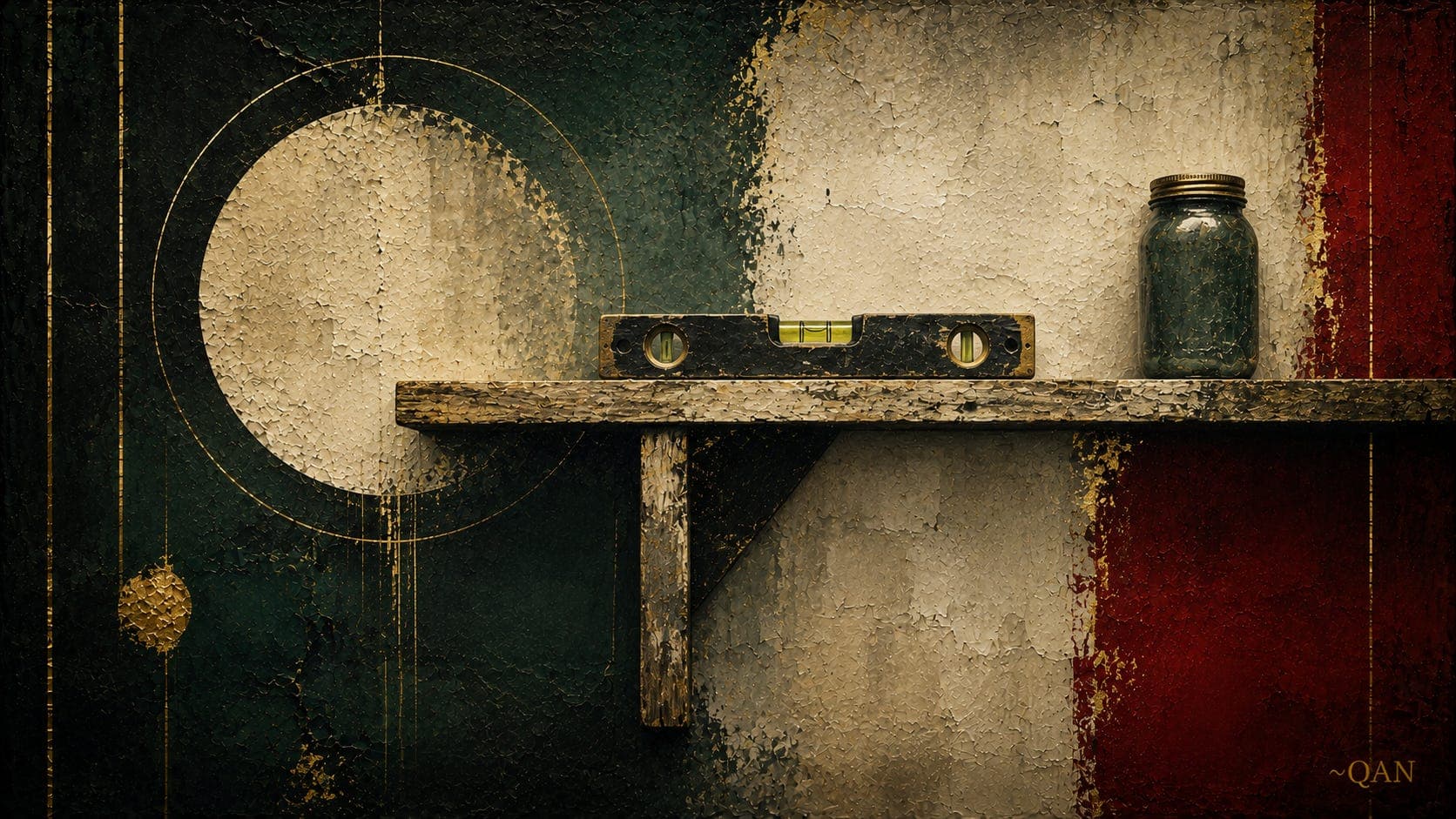
The bubble sits off center. Not by much. A degree, maybe two, the kind of lean you would miss without the tool in your hand.
You could match it. Cut the far bracket to the same angle and let the whole shelf lean together, symmetrical in its error. It would look intentional. It would look like restraint.
You try it first. The second bracket goes in at the matching tilt, and for a moment the shelf looks resolved, two wrongs canceling into something that reads as balance.
Then you set a jar on it. The jar drifts. Slowly, but it drifts, sliding toward the low corner until it stops against the wall. The lean was never balance. It was just two errors agreeing with each other.
You pull the second bracket and check the level again. Same bubble, same fraction off center, patient as ever, uninterested in whether you learned anything from the jar.
This time you shim the low side. A sliver of cedar, then another, until the bubble drifts back and settles between the lines. The level does not register the correction as a victory. It only stops reporting a problem.
No one photographs a shelf that holds a jar without drifting. The proof of the work disappears into the fact that nothing moves anymore.
The tradesman who does this rarely explains the choice out loud. He checks the bubble, adjusts the shim, checks again, and moves to the next bracket already forgetting the first.
Years from now someone rests a hand on that shelf without a thought in their head about brackets or cedar shims. They know only that the wood holds their weight the way wood is supposed to.
The level still sits in the drawer where you left it. It has read a thousand surfaces this way and argued for none of them. What you do with an accurate number was never its job to decide. That part was always yours.
Same instinct shows up with a door in The Door That Told the Truth, where the problem was never where everyone thought it was.