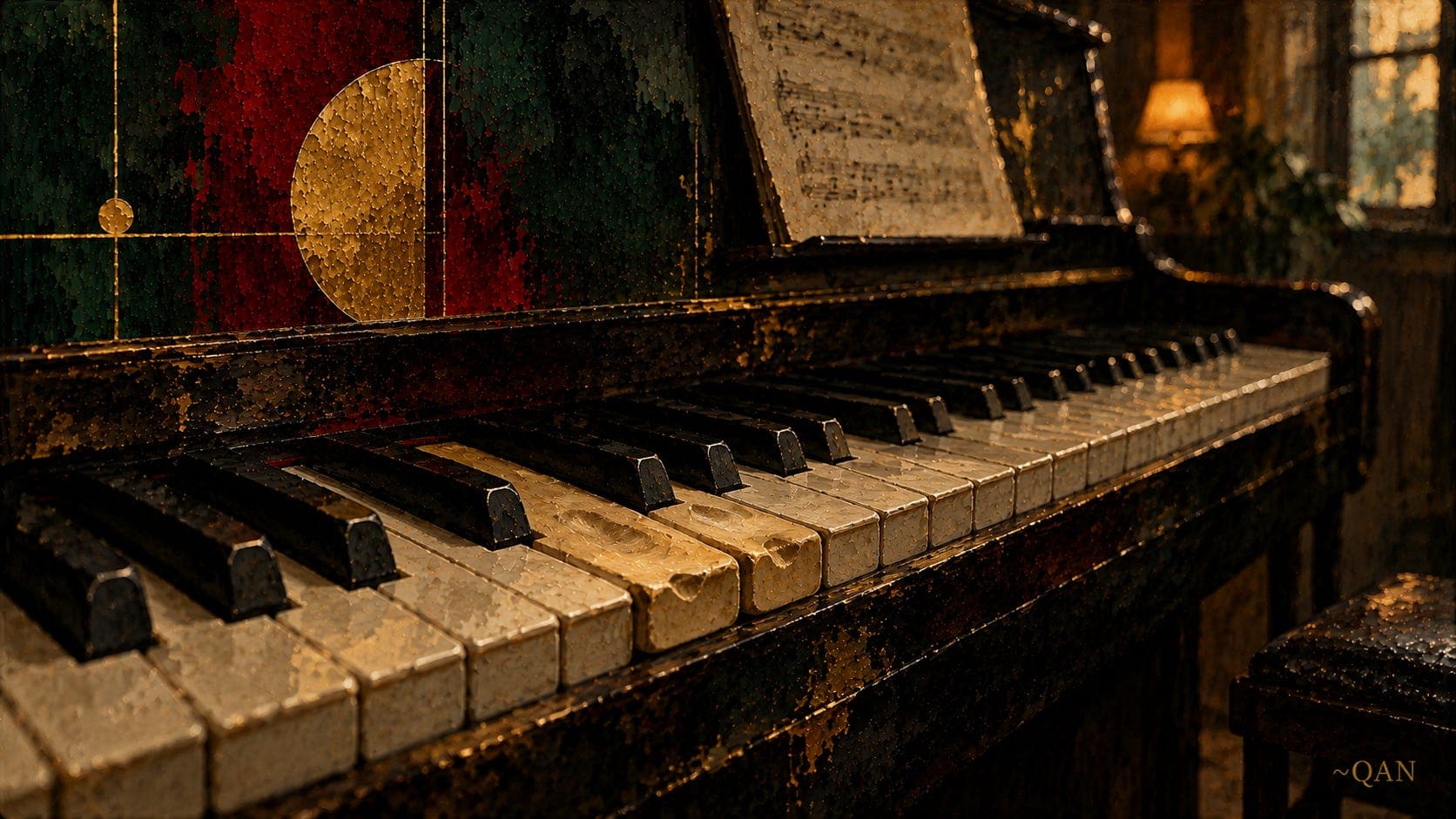
The piano is forty years old, and two keys sit lower than the rest.
The ivory over middle C and the key beside it have gone the same color as old paper. Underneath the color, two shallow dips sit exactly where a thumb has landed ten thousand times, smooth as stones worn round in a riverbed. On a humid evening, the wood still carries a faint trace of the same lemon polish it has carried for decades.
Visitors notice the color first.
Almost no one asks about the dip.
A guest sits down one evening and plays the sonata that gets played most nights in this room. She plays it well. The room fills the way it always fills, warm and a little too loud near the window, and nothing in the sound tells anyone which two keys are carrying forty years of one particular hand.
The wear stays invisible in the sound. Only the wood keeps a record of it, in a place no listener would think to check.
Here is the part almost no one expects. The dip cannot tell whether those ten thousand strikes were played beautifully or badly. It has no ear, only a memory for pressure applied in the same place, over and over, regardless of what that pressure sounded like to the room. A wrong fingering, drilled enough times, wears exactly as deep as a right one. Sometimes deeper, because a wrong fingering that feels comfortable gets returned to more often than a correct one that never quite feels natural yet.
The hand simply goes back to wherever it has already gone the most.
Give that same hand a new piece of music and watch what happens. New notes, a new key signature, a melody with no history in this room at all, as fresh a beginning as a piano can offer. For the first several bars, the fingers behave like strangers, careful, reading each note before playing it. Then a passage arrives that resembles, even slightly, the shape of the old sonata, and the fingers stop reading. They go home. They find the worn dip before they find the note actually written on the page.
The sheet music changed.
The room stayed the same.
The hand went where it already knew how to go.
A second chance replaces the song. The reach underneath it stays exactly where it already was. It clears the room and hands over a clean page. It gives the fingers a real beginning. None of that touches the shape already built into the muscle. The wood does not ask what the old habit cost the music. It only counts how many times the hand came home to it.
A groove worn by repetition is changed only by repetition, done on purpose, for long enough that it stops being interesting to anyone. It takes playing the unfamiliar movement slowly, badly, with no one in the room, far past the point of boredom. Applause cannot check this kind of work. Applause is listening to the song. It has no way of knowing whether the fingers found the old dip and covered it just in time, or found a straighter path and simply got lucky with the notes that night.
The real test happens alone, with no one grading the sound. If the fingers still hunt for the old dip out of habit, the groove is still running the hand, whatever the room heard. If the unfamiliar movement has started to feel ordinary, no longer needing thought, that flatness is the only proof that something has actually moved.
The piano is still forty years old tonight. The two worn keys sit under the lamp, the same color, the same shallow dips a thumb still finds without looking.
But there is a third key now, barely paler than the rest, just beginning to lose its shine in a different place.
Nobody visiting this week will notice it.
It was never for them.
The same instinct shows up with a strip of dirt beside a path in The Shortcut, where the damage never happens on the day anyone would call it a decision.
This week Quiet After Noise crossed 1,000 subscribers here. Thank you for reading quietly enough, for long enough, that this kept being worth writing. As a small next step, everything now also lives at quietafternoise.com same essays, same pace, nothing new being taught there either.