An out-of-tune guitar can hang on the same wall for months.
The strings are still there, the wood still catches the light.
Walk past it and you would never stop to look.
Even when someone plays it, the first few notes sound close enough.
Close enough to remember the song. Far enough to know something has left it.
That is the strange thing about drifting.
It never announces itself.
No morning begins with the feeling that everything has changed.
It happens smaller than that.
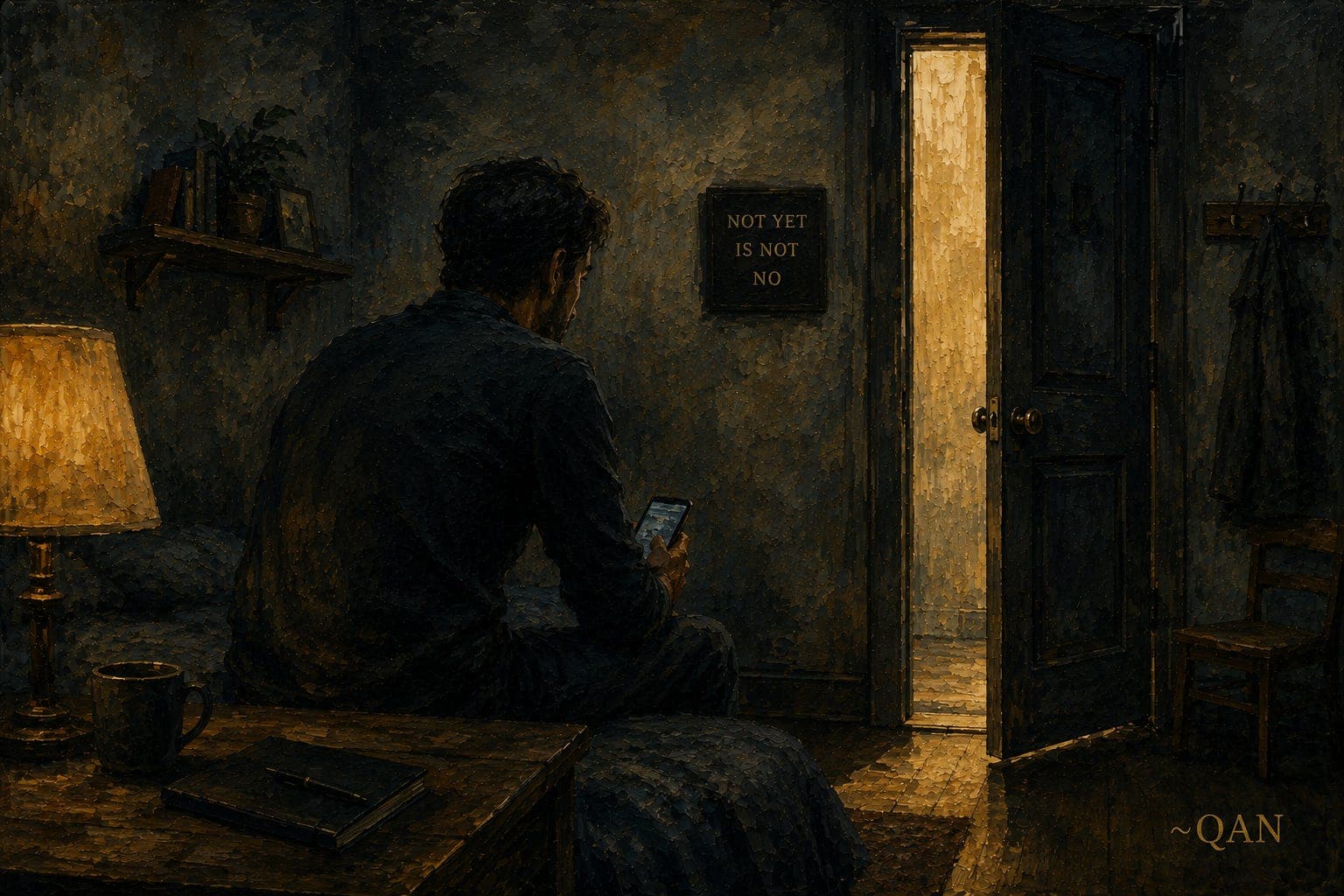
One conversation you never continue.
One apology you never make.
One sunset you stop noticing.
One phone call you keep postponing.
None of it large enough to become a memory.
Just enough, slowly, to become a direction.
You don't hear the difference after a single day.
Neither does the guitar.
But days collect the way silence collects in an empty room, one on top of another, until the distance that was once impossible to miss becomes the only sound left.
Musicians tune their instruments before they perform, not because anything broke.
Yesterday's tuning was only ever borrowed.
Wood breathes.
Strings stretch.
Temperature shifts a fraction of a millimeter and takes a note with it.
Even silence leaves a mark on a string left alone too long.
Everything simply moved.
Quietly, the way people move without deciding to.
Somewhere between busy and comfortable, joy quietly excuses itself from the room.
Nobody notices it leave.
Everyone notices, later, that it's gone.
What replaces it never feels like loss.
It feels like almost.
Almost enough time.
Almost enough rest.
Almost enough gratitude.
Almost enough love.
Almost is one of the quietest words there is.
Most ruin announces itself loudly enough to be feared.
Almost never does.
It doesn't ruin anything.
It just quietly replaces it.
We fear the wrong instrument.
We fear the guitar with the broken neck.
We rehearse that story, brace for that version of loss.
But that guitar never plays again by accident either.
Someone has to notice it, has to decide to fix it or let it go.
The guitar that drifts out of tune needs no one's permission to keep playing.
It will play for years.
It will fill rooms.
People will clap.
And the music will keep leaving it anyway, note by note, without a single dramatic moment to mark the loss.
Nothing here ever needed a villain.
Comfort did all of it quietly, one skipped moment at a time.
Nobody warns you about the days that go well enough.
Those are the days that take the most, and take it so quietly you end up thanking them for it.
I've wondered why tuning feels so different from repairing.
Repair begins after something fails.
Tuning begins while everything still works, quietly, competently, well enough to fool anyone walking past.
No one throws the instrument away.
No one replaces the strings simply because they drifted.
The musician does something quieter than either.
He listens, not to the whole song, to a single note.
Again.
A small turn.
Again.
Another.
Again.
Nothing dramatic happens.
Until suddenly it does.
The note stops fighting itself.
A guitar never argues with the tuning fork.
He doesn't celebrate that note.
He moves to the next one.
Harmony was never the property of a single string.
It belongs to the relationship between all of them.
Maybe that's why so much of life escapes us while sounding perfectly ordinary.
We spend years repairing whatever makes the most noise.
All the while, the thing we're actually missing was never loud enough to notice.
It can't be bought back, replaced, or escaped.
It can only be heard, if we stop long enough to listen for it.
There are moments life hands us that sound back.
An old photograph.
A familiar smell.
A childhood street.
A song unheard in years.
Someone laughing exactly the way they always did.
For a moment, something inside becomes unmistakably familiar.
Life did not change in that moment.
You did, days ago, without noticing, and this is simply the first time you heard it.
Somewhere else, an actual guitar hangs on an actual wall, looking exactly as it did yesterday.
Only someone who stops long enough to listen would know it has already begun to drift.
If this felt quietly familiar, you might find something waiting in The Callus and The Shortcut, too.
I'd be glad to have you here for the next.